(Un)Ethical Non-Monogamy
The new progressive frontier of shagging

When my six-year relationship ended just over a year ago, I wondered what dating in London would be like.
For years, I’d felt a certain smugness—guilt-ridden, perhaps—at not having to endure the London dating rat race. I’d listen to my friends’ horror stories about men in all their various, unflattering forms. Yet, I also found myself somewhat envious of their experiences—of the chance to get dolled up, cheeks flushed with nervous anticipation, and venture into the unknown with a stranger. I was 21 when I met my former partner, and before him, I’d only dated briefly. Our relationship quickly cemented as a long-term one that spanned over half a decade. By the time I was 26, I’d had three long-term boyfriends, so the whole “dating around” thing wasn’t an experience I’d had.
As 2024 approached for newly uncoupled me, I decided it would be the year of dating. I vowed to stay single for an entire year, to experience everything I’d missed in favour of stability and security. I loaded the dating apps, selected a few photos, and waited. After a few weeks with little positive action, a friend recommended an app called Feeld, saying, "People on there are more relaxed about dating. You’ll have fun." And, to be fair, I did have fun.
However, one thing became clear quickly: Feeld was dominated by ethical non-monogamy (ENM). This is because Feeld is a kink app, and ethical non-monogamy and other forms of open relationships are considered fringe.
I wondered, What exactly is ethical non-monogamy? How is it different from regular non-monogamy? Is it just “cheating with a conscience” or a new progressive frontier of shagging? I felt distinctly uncool and unlearned.
According to Google:
Ethical non-monogamy (ENM) is a relationship structure where multiple people are romantically or sexually involved with each other, with the consent of all parties.
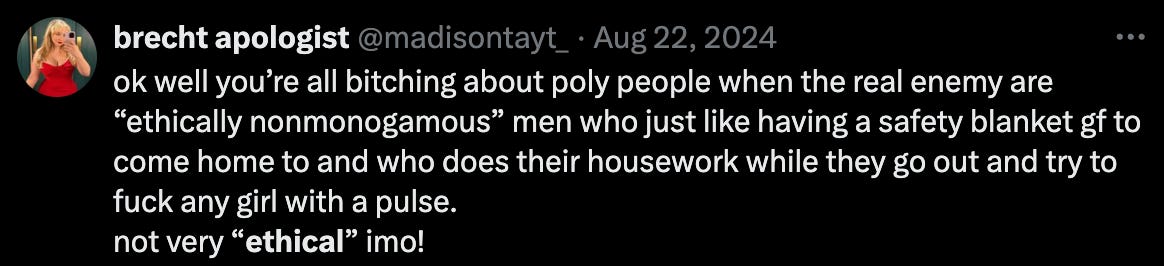
Right then, I thought, "In for a penny, in for a pound," and agreed to go on a date with someone who identified as ethically non-monogamous. What followed could only be described as a year-long social experiment in the world of ENM. I’ve lost count of how many ENM people I’ve dated, but one trend is undeniable, and I shall TLDR it for you: straight, often middle-class men, use the concept of ethical non-monogamy or open relationships as an excuse to sleep with more women without sacrificing the comfort and security of partnership.
(To be clear, I am putting this in a completely different camp to Polyamory, which is a whole different ballgame with very different rules.)
The unspoken implication is that, no matter how entangled you get, they owe you zero emotional responsibility because—well—they’re not really available.
It’s a strange phenomenon. Somehow, it has become easier to find someone else’s husband to shag than to meet a single guy who’s emotionally available. And, interestingly, I rarely meet women who identify as ethically non-monogamous. Granted, I’m straight, so I’m not dating them, but the imbalance is striking.
I’ve had it all: dates with men who reveal they’re married only after the fact, trying to convince me that their relationship is “open” even though they “forgot” to mention it during our two-hour lunch. They also “can’t host,” meaning if you want to hook up, it has to be at your place. (This raises the uncomfortable implication that there’s possibly a woman at home who is blissfully unaware of her newfound sexual liberation.) I’ve also had first dates with men who talk about their girlfriends so much that I was essentially dating her by proxy. At one point, I had to ask him to stop mid-date, because by then, I knew more about her sexual desires and habits than I did my own. I wonder if it was perhaps overcompensation for being uncomfortable with the open arrangement; in the end, he left early because he was missing her.
I’ve also had everything else in between. I’ve seen casual arrangements turn serious, only to realise that ethical non-monogamy quickly becomes unethical when the "third" person begins to seek autonomy or emotional responsibility from their sexual partner. I’ve also noticed how ENM has migrated from more fringe dating apps like Feeld to more “traditional” apps like Hinge; it’s gripped the normies, much to the chagrin of the fringe.
I remember sighing into a margarita with a friend recently after another messy encounter with someone else’s boyfriend. “Is there anyone actually single anymore?” I asked. "No,” she curtly replied.
I ordered another drink.
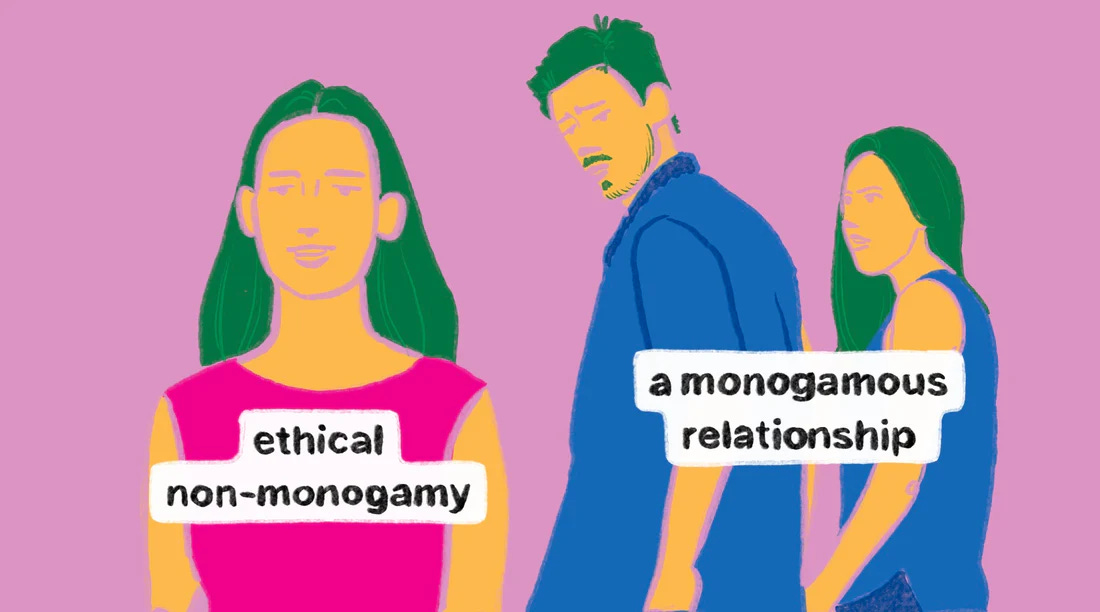
What struck me more than anything, though, is how many of these men weaponise terms like “ethical” as a way to give their behaviour a veneer of higher political consciousness. Many of them will throw around well-researched and informed concepts they’ve read about in books or articles—ideas that seem to imply a genuinely radical, enlightened approach to sex and relationships. They’ll quote The Ethical Slut or mention articles on consensual non-monogamy, as if to say, “Look, I’ve done the intellectual work; I’m in touch with some enlightened new way of thinking.” But when you dig a little deeper, it becomes clear: they aren’t seeking true openness, emotional exploration, or self-growth. They just want to f*ck as many people as possible with as little responsibility as possible, while using these radical theories as a shield against accountability. They’ve co-opted progressive language to mask an altogether basic and selfish desire—a desire to shag around with as few emotional consequences as possible, all while dressing it up as politically conscious or advanced.
Most women I’ve spoken to, whether they’ve dabbled in ENM or watched it from afar, share a similar sentiment: it often feels like being a sexual functionary in someone else’s failing relationship. In the dying stages of a couple’s bond, they open up to sex with others, believing it will repair their broken connection and somehow avoid the chaos typically seen with affairs and so on. The “ethical” part of it, they argue, is that both partners have agreed to it, so it’s not technically cheating. But rarely has any real emotional work been done to consider how the feelings, autonomy, and emotional needs of the third party will be respected.
I can think of maybe one or two people who have managed to practice ENM “successfully,” and they are the exceptions, not the rule. They’re the ones who’ve done the emotional, personal, and relational work, and it’s obvious in every other way they live their lives too.
Politically and socially, I’m open to the idea of loving multiple people and exploring oneself sexually and emotionally. But after observing and participating in this “experiment” for over a year, I can confidently say that, no matter how much someone claims to have read the literature or listened to Esther Perel's interviews, this kind of sexual openness often provides a cover for bad people to behave even worse—without any accountability. They slap a label on it and think they’re immune from criticism. They are not.
Please don’t mistake this for bitterness on my part. I’ve carefully weighed the pros and cons, but I can’t shake the overwhelming feeling that, in nearly every instance I’ve encountered, ethical non-monogamy has been distinctly unethical. When I think about it now, the conclusion I come to is that sex is inherently emotional and complicated. Trying to legislate sex without emotion as a means to avoid complications and have one’s cake and eat it, as much of ethical non-monogamy seeks to do, is a fantasy. Sex isn’t static or linear; it’s fluid. What might begin as a casual one-night stand can quickly evolve into something deeper—an awe-inspiring, earth-shaking romance, for example. Mixing such volatile elements into a partnership that isn’t seeking new emotional or at least committed connection but only new sexual experiences is almost always, in my experience with the current crop of “open” people, doomed to fail.
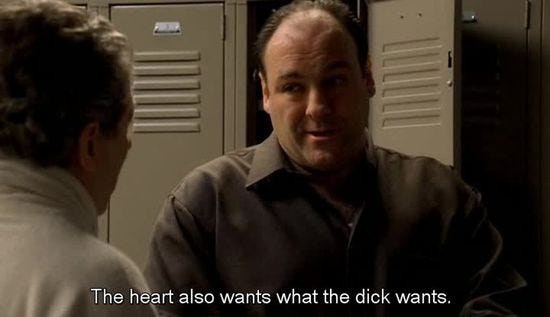
Where I think people fall short is in reducing sex to a mere conduit for easy pleasure. Which, by the way, some people enjoy—which is fine; it’s just regularly this isn’t made clear upfront. Yes, there are ways to have truly “casual” sex, but in practice, that’s often the exception, not the rule. Much of ENM reduces interactions to functionary exchanges, treating sex—this deeply emotional and complex act—as if it can exist in a vacuum. The safety net is this: whatever comes next, the decision to disengage from the mess that follows is framed as an ethical choice. Why? Because they said so, and that’s the end of it. There is no recourse to justice.
After a year of navigating the complexities of modern dating and relationships, I’ve made what some might consider a deeply conventional decision: to return to monogamy. This year of experimentation and self-discovery has been about recognising my sensitivity and vulnerability in the face of an often depersonalised approach to sex. Ultimately, my conclusion is that, like so many areas of life, the key is doing the necessary emotional work—including my own—before venturing into anything that carries more risk than I’m willing to take.
Lots of comments and discussions on this, which is very cool and unexpected! Just to be clear, the piece is not intended to:
A) Trash anyone who is non-monogamous
B) Trash anyone who has casual sex
It is only intended to highlight the unethical behaviour of a specific group of people! Thank youuuuuuuuuuuu.
What you’re describing isn’t ethical non-monogamy though. Your descriptions make it clear that what you’re experiencing by definition *isnt* ethical. It’s why many of us move to the term ‘consensual non-monogamy - non-monogamy (as in, people who are okay with extra-dyadic relationships) isn’t ethical just because we put that word on the front. Polyamory falls under the umbrella of ‘ethical non-monogamy’, rather than being a separate thing, and many people are (in my opinion) just as unethical about that. Hierarchies abound. ‘One penis policies’ are common, unicorn hunting (a couple wants - usually a woman - as a ‘third’ and that unicorn is subject to couple’s privilege- the third has to do what ‘the couple’ want - the third doesn’t get to have what the third wants unless the couple wants it) etc.
I agree that abuse of the term is rampant, and to a large degree people don’t understand it, or think they can make rules to protect themselves (sex only, no falling in love, for example), or think that some kind of ‘consensual’ non-monogamy is the way out of a difficult relationship without having to leave, or without doing the work. And it doesn’t work (and we see it in polyamory too).
But by definition ethical non-monogamy is ethical.
A person can call themselves “a vegan who eats eggs” but that isn’t the definition of vegan and most vegans (who adhere to the common understanding of vegan) would call that person a vegetarian, and also believe that that “vegan” is in fact giving actual vegans a bad name (I use that example as a vegan who at a B&B was asked if I wanted eggs for breakfast because “some vegans eat eggs”), but we don’t get rid of ‘vegan’ or suggest that vegans are bad people because some people are muddying the term.
People using the term in the way you describe are using it to claim some moral high ground that they actually have no claim to, and are deluding themselves and others about who they are.
Consensual non-monogamy done well takes work. Lots of it.
And all too many people (yes, most often men in my 20 years of being around cnm and kink scenes) are using the term as a way to justify bad behaviour. But they’re not doing what they say they are…
They are causing a lot more damage to people however, and using their niche status as a way to draw capital, and that’s awful. I’m sorry you had those experiences (and not surprised given my own understandings).